4.0
Reviewed Feb 21, 2026The course was nice and easy until the last module where some lectures were presented in a very confused way.

Introduction to Computer Vision guides learners through the essential algorithms and methods to help computers 'see' and interpret visual data. You will first learn the core concepts and techniques that have been traditionally used to analyze images. Then, you will learn modern deep learning methods, such as neural networks and specific models designed for image recognition, and how it can be used to perform more complex tasks like object detection and image segmentation. Additionally, you will learn the creation and impact of AI-generated images and videos, exploring the ethical considerations of such technology. This course can be taken for academic credit as part of CU Boulder’s MS in Data Science or MS in Computer Science degrees offered on the Coursera platform. These fully accredited graduate degrees offer targeted courses, short 8-week sessions, and pay-as-you-go tuition. Admission is based on performance in three preliminary courses, not academic history. CU degrees on Coursera are ideal for recent graduates or working professionals. Learn more: MS in Data Science: https://www.coursera.org/degrees/master-of-science-data-science-boulder MS in Computer Science: https://coursera.org/degrees/ms-computer-science-boulder
The course was nice and easy until the last module where some lectures were presented in a very confused way.
Professor Yeh is incredible. Presents information in a way where you find the intuition yourself.
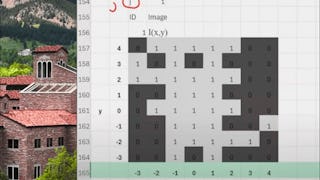
Enjoyed the course. Seeing the math worked through step by step in Excel was extremely beneficial.
A little more explanation on Module 4 would have been helpful
Showing: 12 of 12
While this is a useful workthrough of how computer vision computation works, the assessments are mismatched to course content: many questions are related to material never directly covered in the course.
The course was nice and easy until the last module where some lectures were presented in a very confused way.
Professor Tom Yeh has proven that the success of his Gen AI course was not a fluke. With clear explanations, no busy work, and straight forward practical examples, Prof Yeh stands out as one of the best Universities have to offer.
Enjoyed the course. Seeing the math worked through step by step in Excel was extremely beneficial.
Professor Yeh is incredible. Presents information in a way where you find the intuition yourself.
fantastic
perfect
good
A little more explanation on Module 4 would have been helpful
the last
good
- The Filter2D learner workbook is not updated to the version used in the lecture videos. - His lecture is very mechanical. It’s useful to go through the steps of how to do a thing such as dilating an image. However, he never seems to explain the concepts or what their applications are. This makes his lectures less meaningful. - His way of explaining things is not clear, not precise, and not organized. - Incorrect spelling such as for “epipolar”, he wrote “epiplor” in one of his lectures.